
Interview with Beth Sherman
novella-in-flash, memory loss, the shore

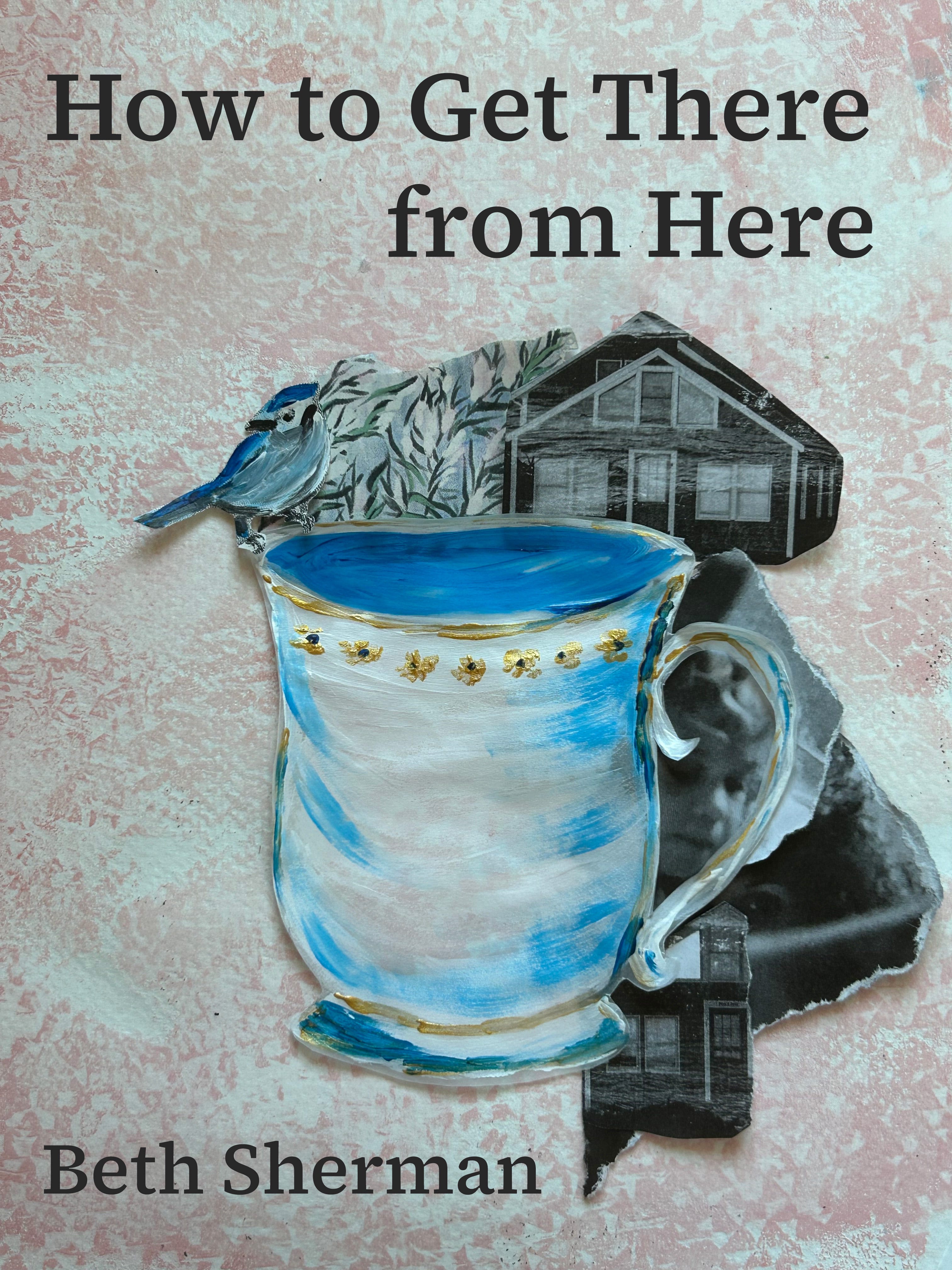
Today we are talking to Beth Sherman, author of the novella-in-flash, How to Get There from Here (Ad Hoc Fiction). She is a Submissions Editor at Smokelong Quarterly and her work has appeared in more than 250 publications, including The New York Times, Newsday, Portland Review, Smokelong, and Fictive Dream. She’s also the author of five mystery novels. I was very curious to read How to Get There from Here, to follow a larger story through fragments, and I loved it. This is such a touching, complex story. Now, onto the questions!
I loved the format of How to Get There From Here, how it quilts fragments into one overarching story about a woman (Lauren) trying to care for her mother (Sylvia) after her mother’s Alzheimer’s diagnosis. Did you know in the beginning that this novella-in-flash format would work best for telling this story, or did you discover it along the way?
I initially felt that the novella-in-flash format would be perfect for this story because its form echoes the fragmented nature of Alzheimers. The dementia mind darts here and there, circling back on itself, ducking and weaving, losing the thread and picking it up again.
When did you decide to write about caring for someone with Alzheimer’s?
My mother suffered a series of strokes that affected her cognition. She had aphasia, where she would reach for a word and not be able to find it. And she had difficulty processing information and understanding what was being said. I feel like I will eventually get dementia myself. I’ve always had a bad memory and it’s become worse as I get older.
Beyond that, I wrote the first story in last year’s Smokelong's March Micro Marathon and then wrote the bulk of the other stories in A Smokelong Summer. That first prompt was to write a 100 word story dealing with a loved one’s forgetfulness. That became “To Do List: Buy Sharpies.” It was the first piece I wrote, though it appears about midway through the book.
You explore some of the humor in these difficult circumstances, the painful bluntness and stubbornness of her mother after her diagnosis. There are also moments of swift poetry, particularly as Sylvia’s thoughts become less ordered. What was your process like for crafting these different voices? Which parts came quickest, and which were more difficult?
It was so hard to get the voice of Sylvia right! I really struggled with that. To put myself inside the mind of someone whose mind is fraying. Yet, as you point out, those chapters are my favorite because while disjointed, they’re also the most poetic. It’s where the language tends to shine. Writing Lauren was easier because she’s more like me – a caregiver, a worker bee, a list maker. Someone who’s doing the best they can but who also feels guilty about not doing enough.
What was your publication process like for How to Get There From Here?
I knew I wanted to enter the Bath Flash Fiction contest for novellas-in-flash. I’ve read so many of the books Ad Hoc has published and admire them so much. When my publisher emailed me in March to tell me I was one of three winners, it was the happiest day of my writing life!
How long did you work on this book, and how long did it take to place portions in lit mags?
I started working on it last summer. It took about four months to finish and revise, during which time I managed to place 28 stories in literary magazines.
Setting is important to the story, the transition from the city to the suburbs, with occasional forays to the beach. What’s your favorite landscape to visit? And to write about?
Sylvia loves the beach, as do I. It’s beautiful, relaxing, and luminous, looking different at different times of the day. I’ve also written five Jersey Shore mystery novels, set in a fictionalized version of Ocean Grove, NJ, where my main character lives a block from the ocean.
The mother-daughter relationship in the story feels so real. Sylvia isn’t a saint, but a real and incredible person who is smart yet stubborn, loving yet sometimes distant. I loved moments where Lauren remembers small details her mother no longer can, like her missed prom and the shrimp at her wedding, and how this shows us different sides of Sylvia. There’s always the question as the disease progresses, is the old Sylvia still inside somewhere? In crafting these characters, how did you walk the tightrope between idealizing and catastrophizing about who Sylvia was in the past and who she became after the onset of the disease?
That’s a great question! I didn’t want to idealize Sylvia. Yet I didn’t want her to come across as a victim. She knows something’s wrong but she doesn’t want to accept it. She loves Lauren, but she also resents her. She escapes Lauren’s house and catapults herself into an unknown future, an act that is both brave and reckless. I found her to be a very complicated character.
What question would you like to be asked? Please answer it!
Did you intentionally try to make this book flash-y? Yes! Flash lends itself to experimentation. So I have chapters that are lists, chapters that consist of one breathless sentence, chapters that feature an extended metaphor, chapters that read like prose poetry, chapters that are diary entries, and so on. I wanted to take full advantage of the form.
Can't wait to read this!! I love the interview.
Great interview! I love the flashy nature of your book, Beth.