
Interview with Joey Hedger
Deliver Thy Pigs, community, going veg

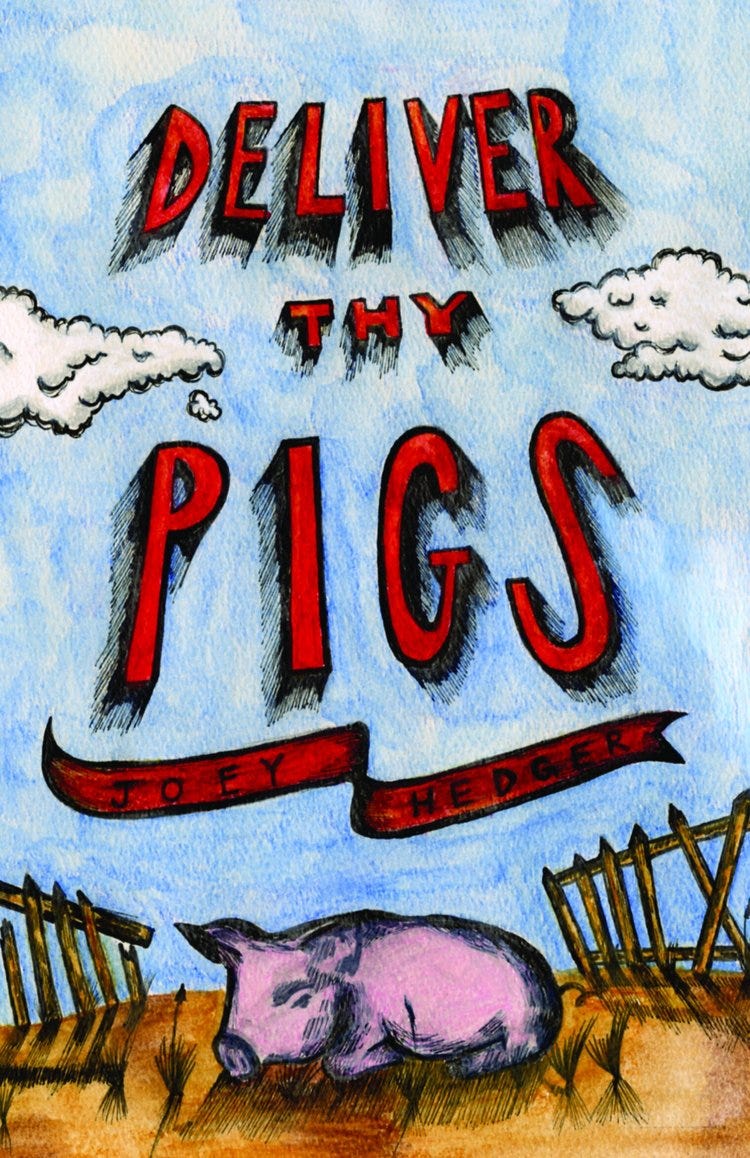
Joey Hedger is a very friendly guy, the author of Deliver Thy Pigs (Malarkey Books, 2022) and In the Line of a Hurricane, We Wait (Red Bird Chapbooks). His writing has appeared in The Islandia Journal, Daily Drunk Magazine, Variant Lit, McCoy’s Monthly, Complete Sentence, Posit, and Flyway Journal. His poetry won first prize in the 2019 Florida Loquat Literary Festival. A Florida native, avid lover of nature, and amateur birder, Joey currently lives in Alexandria, Virginia, where he edits for an education nonprofit.
Deliver Thy Pigs has been on my TBR list for a long time, and it finally came up in the queue, and I loved it! Joey reveals in the interview that the book has been out for four years, which doesn’t seem possible. The time goes so quickly. But this is a great reminder to read indie books from four, fourteen, forty years ago. That’s how you find the gems.
When did you get into writing, and who were your early inspirations?
I’ve always been writing. As I kid, I remember filling out these writing prompt books, where each page started with a line, and you had to create a story out of it. Then, I started handwriting all sorts of nonsense stories on printer paper that I’d fold up and hide away in my drawers for some reason. Looking back, I appreciate being encouraged to write made-up stories. It feels useless in a way that draws me to it. Lots of people I know now dislike fiction because it feels useless, like they’re wasting their time reading it. But, God, nonfiction can be so boring to me, especially “useful” nonfiction like self-help or business books. There’s a fantastic Ursula K. Le Guin essay called, “Why Are Americans Afraid of Dragons,” that speaks to the perceived uselessness of fiction and fantasy far better than I ever could.
I began taking my writing more seriously in college, took a few courses including one on writing for publication, where my professor showed us all the basics—writing a cover letter, creating and folding a SASE, how to take rejection. Honestly, it was all so helpful. My first publication was in my junior year of college, a poem about the clouds looking like ships in the morning sky, because I was looking at clouds, one morning, and they looked like ships. It wasn’t very good, but that’s the thing: Getting embarrassed by your own writing is probably a sign you’re getting better as a writer!
Early on, I found a bit of inspiration from the usuals: I enjoyed some epic-feeling fantasies like The Lord of the Rings or the Redwall series by Brian Jacques. Most of my writing as a kid was cheap Redwall rip-offs, actually. I loved The Martian Chronicles by Ray Bradbury. My mom was big on the British classics, so I’d read a lot of Austin, Dickens. In high school, I thought it was cool and distinctive to read everything by Hemingway and try to write like him. Boring answer, but it wasn’t until I was older that I started reading outside what you might find in a school curriculum.
Deliver Thy Pigs is about fairly ordinary people trying to survive under ordinarily difficult circumstances, all putting their heads together to confront the local corporate slaughterhouse that ruins the town’s quality of life. I loved the genuine sense of community in the story. Have you ever lived in a small town that felt like this?
Actually, no. I’ve only really lived in two places: Tampa Bay area, where I grew up, and Northern Virginia, where I live now. Both are quite large by hometown standards. Deliver Thy Pigs is modeled after my wife’s hometown Algonquin, Illinois. It’s a small town about an hour or more outside Chicago where we spend a good bit of time. It’s big though, now. Over the past few decades, it’s been in a transition point between rural and suburban, cornfields and shopping malls.
I like novels that have a strong sense of place and of community. It’s so easy for writers to give their characters “main character syndrome”—to feel like their reality is the only one that matters. But that bores me. I like shifting points of view. I like communities. I like when everyone has agency, feels alive and different. I like knowing my neighbors in real life by the names of their dogs and imagining that’s how they know me right back.
After reading Deliver Thy Pigs, I definitely wondered if you were a vegetarian. I’m not, but I’ve significantly reduced my meat consumption, and it’s something I think about quite often. Did writing the book shape your viewpoint on this?
Yes, I’ve been mostly vegetarian for the better part of a decade. I say, “mostly,” because it started out largely as a major reduction of meat consumption, because I thought going all out would be too difficult to achieve—I was wrong; it’s easy. Now, it’s a steady commitment. Strap me to a lie detector, and I’ll admit there’s areas where I’ve not been 100% pure, but that’s mostly for convenience reasons, not because I’m sneaking off to Buffalo Wild Wings after dark for a late-night snack (though, come to think of it, I’m pretty sure they have vegan wings now too).
Writing this book was an extension of my thinking about diet, because becoming a vegetarian, for me, was always about lessening my carbon footprint, thinking about my own impact on the world around me. But it’s complicated, because what does it matter the things we do as individuals? Sure, I can keep my apartment warmer during summers, or bring my food scraps to the local compost bins, or take the bus to work. Meanwhile, they started calling Northern Virgina “data center alley” because of how many they’re building, and locally, we’re already seeing the toll.
In my book, I wanted to write about impact without being naïve but also while praising the miniscule, the small acts of goodness like planting trees, freeing caged animals, or even shooting out factory windows with a B.B. gun. It’s all personal to my characters—like a diet—and it’s all meaningful, even if not largely world changing. Maybe something meaningful does come from all of it, an occasional breath of fresh air or a slightly cleaner river. Maybe it’s worthwhile still.
Give us the rundown on releasing a book with an indie press, in this case Malarkey Books. What are some steps you’ve taken on your own to get the word out about the book?
I loved publishing with Malarkey Books. I suppose—Malarkey is my only experience publishing a full-length title—to paraphrase Anna Karenina, major publishers are all alike; every indie press is indie in its own way. Alan Good (who runs Malarkey) has a clear, strong passion for the books that he publishes. If you’ve ever looked at the website, you can tell that Malarkey lacks a specific theme. It’s got literary fiction, horror, poetry, weird fiction. And yet, they’re all quality; they’ve all got heart. At AWP in Baltimore, I got to sell books at the Malarkey table, and it was so fun asking people what they like to read and being able to say, “Oh, I’ve got just the one for you.”
In lieu of genre, what Malarkey does have is community. I don’t know if this naturally happened or if it took all of Alan’s energy to do so, but there’s a real community feeling there. The writers who published with Malarkey are all huge supporters of each other and are constantly uplifting and promoting each other’s works. I’ve met a number of them in person over the years and consider them real friends. I don’t get the sense that such relationships happen across the Big Five publishers.
Publishing independently, you’re your own biggest advocate. Admittedly, I’m not a great advocate. Deliver Thy Pigs came out about four years ago, and I’d sent it to places for review or awards, tried to promote it online, posted about it on Twitter. I included a recipe for homemade deep-dish pizza in preordered copies. Alan also published an essay of mine in conjunction with the book, where I asked the question, “What does your town smell like?” since smell is such an important part of the story, and it led to some really interesting reflections from readers. One example, I learned about a slaughterhouse here in Alexandria that kept getting in trouble for selling illegal meats and was in a legal battle with the adjacent neighborhood because chicken feathers kept tumbleweeding down the street.
Looking back, I wish I had put more effort into joining readings and touring it around more, because there’s something really cool about allowing literature to build real connections, to let you meet real people in your own community, but we were still pretty in the midst of the pandemic around then. Plus, I’m pretty shy.
What’s your writing routine like now? Do you have any projects underway?
I’m a big believer that the only way to write well is to read widely and a lot. For me, reading is my creativity fuel. If my reading habits are bad, so are my writing habits. It’s all directly correlated. Sometimes, it takes reading a book or two before I can even get down a quality page of my own. I also think it’s immensely important to “participate” in the community you want to join. Don’t send stories to magazines you don’t or wouldn’t read. Buy indie books if you want to publish with indie presses. Be a reader if you want to be a writer. I just don’t understand other mindsets.
I’ve lately been focused on short fiction, which is my first love. I’m just finishing up a story collection that I will start sending around once I finish editing it. I was surprised to write Deliver Thy Pigs as a novel. It was a short story first about a guy who uses a B.B. gun to shoot out windows at the local slaughterhouse, because he’s angry about the smell. The book pretty much turned into that but with wings.
It takes a while for whatever I’m writing to find its identity. A novel may become a story, which may become a screenplay—because, why not?—which may then become a story again but in third person instead of first. Then, I may scrap it all and rewrite the whole thing as close to the first draft as possible. I feel like I marinate a lot. I think one of the greatest skills a writer can have is patience. Patience and taste. The problem is, my pieces often marinate so long they become overcooked, inedible. I like to abandon things. I need to remind myself, sometimes, that my best writing ends up being the pieces that evaded me the longest.
Except for Deliver Thy Pigs. Again, I wrote that one weirdly quickly.
Your bio mentions that you’re an avid birder, and the fate of birds is often mentioned in Deliver Thy Pigs. What are some good finds you’ve had? What worries do you have about birds?
Lately, I’ve been spending a lot of time at Huntley Meadows Park over near where I live in Alexandria, Virginia. A few months ago, a pair of great horned owlets fell out of their nest and, thankfully, survived, but because of the poor state of the nest, some wildlife rescue group had to climb up the tree and replace it with a basket. It was a whole ordeal. Apparently, the wildlife group teamed up with a local tree services company to help them safely climb up and secure the basket. It worked, and I got to watch the owlets grow up.
Owls worry me. It’s not uncommon for owls and other raptors to die from eating poisoned rodents. We’re so eager, sometimes, for solutions to our inconveniences that we don’t pay attention to the ripple effects. In my apartment, we had some mouse issues a couple years ago, and we did the whole humane approach. I’d put out the little plastic cages and fill them with anything I thought the mice would like—peanut butter, bits of cracker, cheese. My wife Kate accused me of serving them little charcuterie boards, which … okay, fair. But man did they resist the traps. You get tempted to go more extreme. Poison is easier, quicker. But I didn’t use it. I caught mice eventually, drove them to the park two miles away like you’re supposed to. Maybe they’ll show up again eventually; maybe none of it really worked or was worthwhile. But I got to watch those owlets grow up, so that’s something.
To answer your actual question, I’ve gotten into photography over the past few years and have nabbed pictures of a decent number of cool birds in the area—eagles, osprey, herons, swallows, mergansers, finches, wrens, phoebes. I’ve been chasing around this belted kingfisher that lives along Holmes Run, and once I get a good picture of that one, I’ll be pretty pleased.