

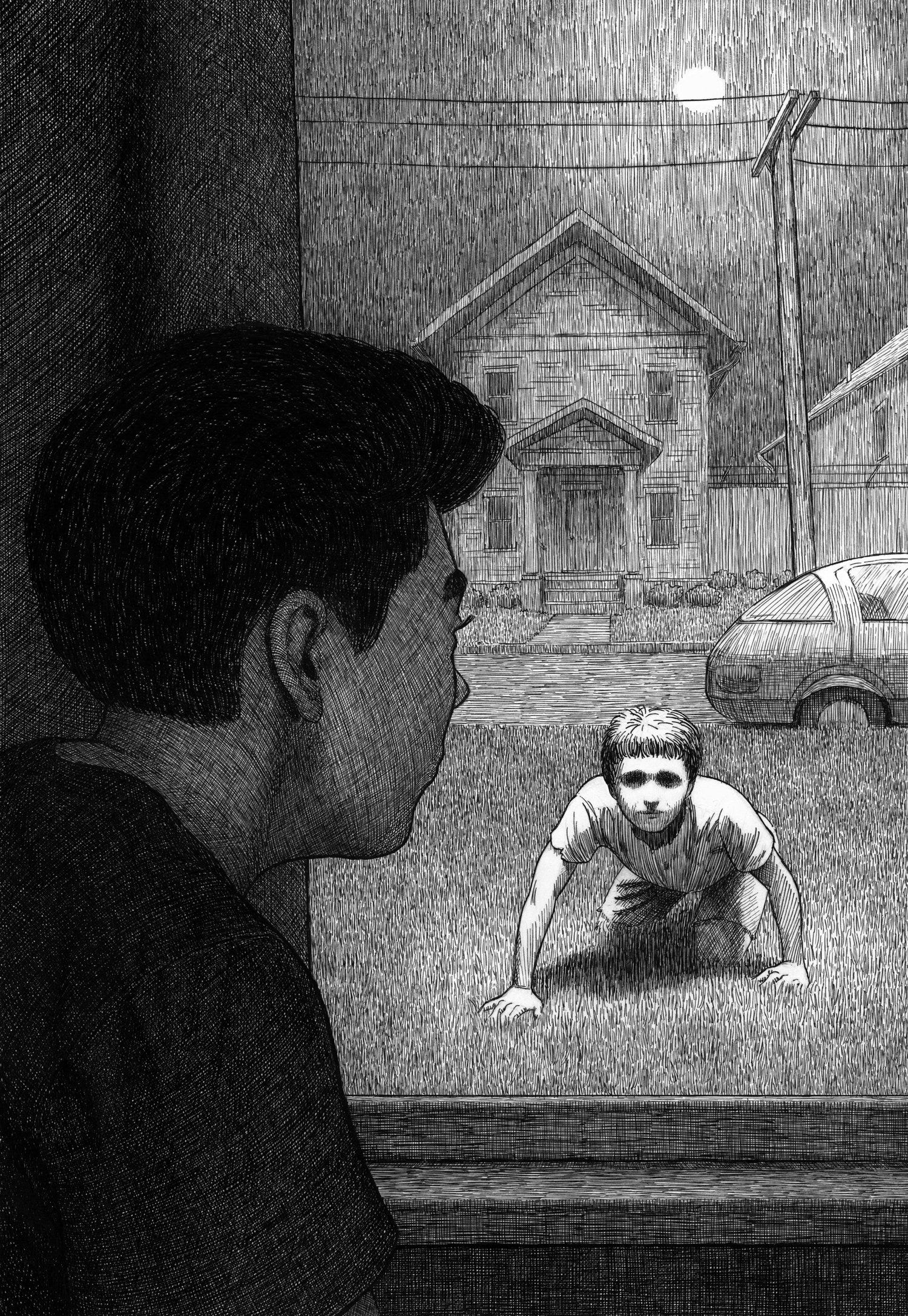
Art by Dan Rempel for Thomas Ha’s “Window Boy” in Clarkesworld
Well, well, well, if it isn’t Thomas Ha. His short speculative fiction has been everywhere, from Clarkesworld to Nightmare to Lightspeed, and he’s been nominated for many awards, including the Nebula and Shirley Jackson Awards. His story “Window Boy” is a touching and thought-provoking tale that’s recently received many nominations.
He works in multiple genres, and I’m a fan of all his ventures! His stories are known for their deep explorations of social issues and taut yet lovely prose. Fortunately, he’s agreed to answer some questions. If you have any questions for him, ask them in the comments!
How long have you been writing, and what inspired you to start?
I’ve written on and off for as long as I can remember, but I started writing seriously about four years ago. I’m very much a part of the “pandemic class” of short fic writers that boomed when the world shut down. I had recently transitioned to being a stay-at-home father a few months before that, and then everything outside went sideways. At that point, it sort of felt like a “now or never” situation. If I wasn’t going to buckle down and see what I could do with my writing then, I never would. So I gave it a shot. And then another shot. And after a lot of shots and misses, I slowly, incrementally, built a small body of work.
You've published literary fiction as well as sci-fi and fantasy and horror, and sometimes combinations thereof. Do you think you'll settle in one or two genres, or does experimenting with different genres inspire you?
I think I have the most fun at the borders of genres, so I don’t think I’ll settle squarely into just one mode of storytelling. A lot of my stories have a dark tinge, so they end up being grouped into horror-sci-fi or dark fantasy or horror fantasy. But I’m also a big believer in not trying too hard to categorize your own work. I’ve heard a lot of writers lament (and I had this thought the first couple of years of writing as well) that their work does not always “fit” well with certain genre boundaries or aesthetics. But I think it’s best just to write the story you’re inspired to write and leave precise questions of classification to critics and readers as much as possible.
My least favorite writing discourses on social media are about genres and subgenres, e.g. is this cozy, what is [solar/lunar/hope/steam]punk or ____core, etc. I get that writers are just messing around and sometimes it’s fun to speculate and argue, but I think it can be a corrosive way to think about writing too. I prefer it when writers do what they do and disregard the boundaries as much as possible. Because whether you like it or not, other people will very forcefully try to tell you what you write and where it belongs. And you can ignore them or listen to them later if you really want, but I think it poisons things if it gets to you too early on.
Many of your stories explore the act of perseverance in contending with a cruel society. What inspires this message, whether in your life or the art you love (or both)?
That’s an interesting way to put it. I think you’re right, and I think it’s a combination of things. I could say the emphasis on cruelty in my writing is because of the world we live in and terrible current events—and it’s particularly bad right now from my perspective—but the truth is probably that I’m a depressive. And my brain rejects a story if it’s too rosy. I’ve read too many stories where truth and perseverance change the world, and while I think stories like that serve a vital function for many readers, they do very little for me. I still believe prescriptive, idealistic writing is as necessary and important as descriptive writing, but I find the former a lot more troubling somehow. If you identify too much with altruistic heroes, you assume you’re similarly equipped to do the right thing, when I think the truth is a lot more mundane: we don’t recognize dangers when we see them or really help people when they beg for it. Not out of malice. Not even out of indifference. Just out of total disassociation and programmed assumptions that things will work out for others, even if that’s not the case.
That said, you could just as easily flip that and say dark, depressive writing, when overdone, has countervailing downsides. Too much despair leaves readers purposeless and doesn’t address anything either. It can be self-indulgent, self-involved. So I think that’s why I’ve often tried to settle on the balance you’ve pointed out, between perseverance and cruelty. I think too much of one side, and you’ve got a fable that feels unrelatable, but too much of the other, and what’s the point of reading a story to the end?
How has being a parent changed your approach to storytelling? Do you tell original stories to your kids?
Hm. I want to say my writing is “deeper” now, but that sounds a bit like parent snobbery. As I mentioned before, I only started writing seriously very recently. But, like probably everyone, I wrote here and there for myself when I was younger in my teens and twenties.
It’s funny looking back on that earlier writing because I think I was smarter then (I can barely hold a thought in my head and have the memory of a goldfish now), but my stories before still felt…empty. Cooler ideas. More interesting action. Really up my own ass in a way that only an overconfident young person could write. But what was the point? I’m not sure there was one. I look at old notebooks scribbled with complex fantasy worlds and planned epics. But I don’t think I knew what I was writing for, if anything.
After I had kids though, I don’t know. I think a lot about them, all the time. And there are things that bubble to the surface that I can’t articulate in any way but a story. Like, oh this here, this is what I’m really afraid of right now. Or this is what makes me feel sick and keeps me up at night. This is what brings me a little secret joy. Or this is what I think is really important.
I don’t know if it has to do solely with my having kids or having my ass kicked over the years, but I suddenly have more built up pressure behind the things I’m writing. I’m not trying to prove a point, but there’s a new kind of urgency. Maybe it’s because my kids are growing up quickly? Because I’m more certain in the feeling that, oh shit, I’m going to die? Who knows. But there’s something pushing the writing that didn’t exist before my kids. I don’t know how else to explain it.
As for original stories I tell my kids, you know, I think they’re at an age where they’re the ones telling me kooky stories now. And that’s great. I prefer to listen to their wild ideas anyway.
Do you find that your favorite stories of the ones you've written overlap with others' opinions? What are some of your stories that you’re most proud of?
Oof. You know, that’s tough. It doesn’t always line up. Sometimes people love stories I love. Sometimes they love ones I don’t. Sometimes they hate them all! But you never want to be ungrateful or say, hey, no, don’t react that way to that one!
I think I’ve learned that I can’t really predict what will draw or repel folks, and I just have to let go. In the same way that the stories are the stories, and I can’t force the conventional ones into an unconventional shape or make the unconventional ones more conventional, I can’t really lead readers one way or the other. So I’m just writing what makes sense to me for each piece, one at a time, and if it clicks with someone, I think that’s great. If it doesn’t, that’s okay too. I don’t want to take any of it for granted. If they’re reading at all, or at least curious enough to come back, that’s a win for me.
My favorite stories are still the ones that I think unsettle readers with their lack of explanation. All of my stories leverage ambiguity to some degree, but the ones that take that a little farther are usually the most fun. A recent one, “Alabama Circus Punk” in ergot., which plays with a breakdown of language and perception, was like that. So was “The Mub” in Clarkesworld, which felt like it hit people in a similar way. Those types of stories are the ones that get me e-mails from readers or lead to fun forum posts out in the internet wilds where people discuss what a story means, what it doesn’t mean, and maybe, most importantly, what they felt going through it. There are also readers who absolutely hate those odder stories and will write angry reviews or lengthy screeds. But strangely, those folks are some of my most engaged readers, I think, and they actually see a lot of the purpose of the story and its shape. It’s just not their cup of tea. And I respect that. Riled and engaged is still often better than a chill thumbs up or a neutral pat on the back, to me.
What are your plans for future projects? Are there particular areas where you're planning to experiment?
Tough to say. I think I’m getting to a point where patterns are starting to form in my writing, and I’ve got a big enough body of work that I want to start seriously thinking about a collection in the next few years. It didn’t make sense to me before, but it’s starting to make sense now.
Other folks I know have done interesting themed collections (like you, Ivy, with Glass Stories forthcoming with Grimscribe Press!). So I’ve been thinking more about the themes I write and how I might group them together too.
But in the short term? It’s still going to be the day-to-day short story grind for me!
You build very strange and vivid worlds in your stories…where do the images come from? Do you tend to see pictures vividly in your mind, or do you work to conjure them?
That’s a really interesting question. Editor John Joseph Adams recently posted on Bluesky about having aphantasia, a condition where you don’t really visualize ideas with a mental picture. It led to a lot of fascinating discussion among spec fic writers, especially how it can vary for some of us depending on subject matter.
I realized, for example, that I don’t visualize people when I write—their faces, their individual characteristics—those don’t really come to mind for me, which is probably why I spend so little time describing them. But environments, buildings, animals, creatures, I tend to picture in a lot more detail. Where the images come from though, is hard to say. I definitely look to a lot of visual art and my own memory and dreams. Many of my settings and worlds feel like amalgamations of places I’ve seen or lived in.
But I don’t ever think about images in terms of their visuals as I’m writing them. It’s more about feeling, if anything. Any descriptions are usually just a means to an end, either the rhythm of the prose or slowing down the story or drawing the reader into a moment. I think if I were more visually talented I would have thrown myself more into visual art or filmmaking or some medium other than fiction. Because I think with writing and its interiority, the descriptions and images are supposed to unlock something else. At the end of the day, whatever my reader imagines when I use a word or a phrase is going to be a thousand times more powerful than anything I could try to pin down with my flimsy descriptions. So what I’m really trying to do is less paint what I see in my head, and more suggest, conjure, and open up some experiential hallucination in someone else. And sometimes too many words get in the way of that, and less visual description is worth more. At least for me!
Thanks, Thomas!!
"My least favorite writing discourses on social media are about genres and subgenres... I get that writers are just messing around and sometimes it’s fun to speculate and argue, but I think it can be a corrosive way to think about writing too. I prefer it when writers do what they do and disregard the boundaries as much as possible." Well said, I couldn't agree more.