
Interview with Travis D. Johnson
"terrors and wonders," folklore, Frolic Press

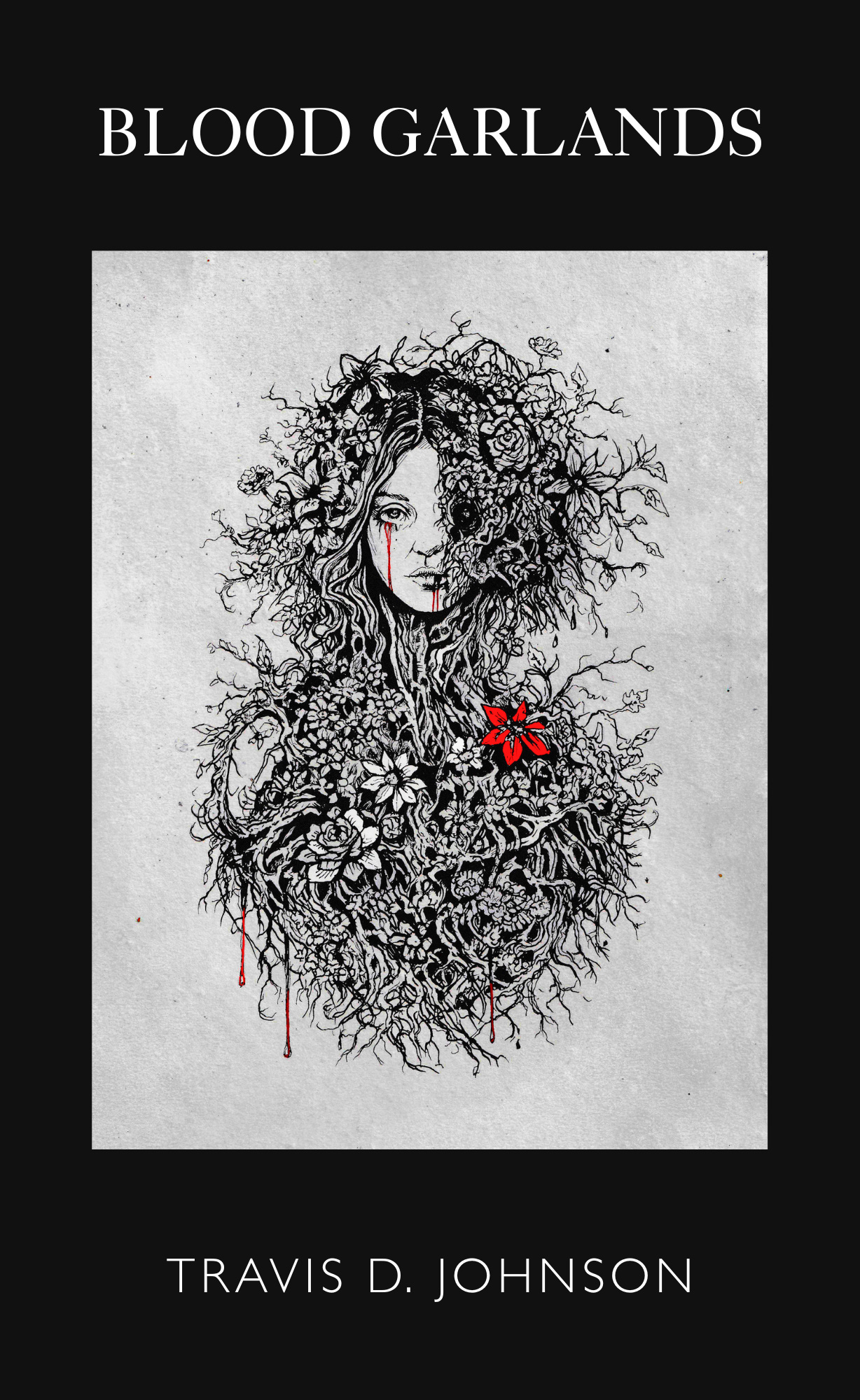
Travis has been very busy compiling his story collection Blood Garlands, wrestling with the awful beauty of nature, gathering oral folktales, launching a new speculative press (Frolic Press), attending to other secret projects, and reminiscing on the surprising details of his life.
I read an early copy of Blood Garlands and loved it! (My thoughts are included in the link.) It’s got everything…fairy tales, folklore, fabulism…all my favorite things, composed with crisp, compelling prose. His stories surprised me, and so did his answers to my questions! He’s lived several lives already, it seems.
The stories in Blood Garlands are such lovely compositions, and so surprising. I thought the first half of the collection was more in the tradition of fabulism, while the second half delved further into the forest of fantasy. Have you been inspired by a variety of genres?
Oh, yes, many genres! The first stories I remember hearing were folklore. My mother would read to me from Egyptian, Greco-Roman, and Norse mythology, the Matter of Britain, the Bible. Retellings for children, of course—many by Roger Lancelyn Green—but I was precocious and pretty soon I was struggling my way through Le Morte d'Arthur. I was very much taken with Arthur, and more so with Morgan le Fay. My younger brother and I spent a lot of time pretending to be Arthurian characters. I think it was very natural that I would move on to modern fantasy. I found Ursula K. Le Guin's Earthsea books—the old Bantam editions with the wonderful cover art—and immediately knew that they were for me.
At the same time, I was growing up on a farm in O'Brien, Florida, which is a little unincorporated community in Suwannee County. We lived so far out that we didn't even have electricity for some time. There wasn't often television or radio reception. We'd go into town about every week to get books from the library, But, mostly, folks in O'Brien were oral storytellers. It was very much like Harry Crews said. "Stories was everything and everything was stories."
So we'd listen to old Mr. Moore with his glass eye tell us how, when he was young, he dove into the spring and his eyeball popped out. And a lot of the stories that were told were not only folklore but folk belief; all children believed in the Luraville Goat Man, who might carry you off in his sack if you weren't good, and even the grownups knew that hoop snakes were real. That oral tradition has always been as important to me as literature.
I discovered horror literature when I discovered Poe. I read "Berenice"—which shocked me. And I thought, "Well, if you can write that, you can write anything!" So, I decided I'd be a writer.
Science fiction has been an influence. I think that the story "Four" in Blood Garlands is science fiction. That's the one that's been met with the most confusion.
I try to read widely, but the truth is that realist literature is only rarely interesting to me.
The biggest influence on my work is the blues. It's in the cadences. Muddy Waters said that before he heard it called the blues, he heard it called "haunting music". And listening to Blind Willie Johnson on 78 is like hearing a ghost.
I did sequence the stories in Blood Garlands in such a way that the last three could be read as being set in secondary worlds. But "The Shorter Path" is really set in post-Civil War Florida or Georgia during the timber and turpentine boom.
Fascinating! How do you feel about living with electricity now? Do you ever think about going off-grid? It makes sense that you lived without electric lights for a time, because throughout your stories, I get a sense of nature in its rawest form, which is beautiful, but also dangerous...the true terror of the lonesome woods at night...the too-many stars and weeping resin and monstrous tree trunks. What's your relationship with nature?
Well, I quite like living with electricity! It’s good to be able to listen to records, watch films at home, talk with you via email, and share YouTube clips of Harry Crews! Of course, there’s a price to be paid: electric power generation is one of the major drivers of environmental degradation. In my stories, the natural world is malevolent because it reacts to extractive violence, whether that violence is historically real (turpentine camps) or symbolically abstracted (I associate tears with jewels with snails with stars). I really don’t like it when communities are exploited, be they wild communities or human ones.
Growing up right on the eastern bank of the Suwannee, everything on the other side was deep dark woods—miles and miles of it—until you reached the Gulf of Mexico. And I loved those woods; I’d ramble in them for hours. They’re beautiful and also terrifying. And I have this theory—which I guess is a theory of the sublime—that everything truly beautiful is frightening. I think that’s why we have that word “awful”. George Eliot, in The Lifted Veil, wrote of “the presence of Nature in all her awful loveliness.” My Anglican priests like to speak of “terrors and wonders”. And I always say that the wilderness is the Other Church.
So, my relationship with nature is one of awe.
At one time, I did have it in mind to move back to the country, but I injured my back very badly and would have a very difficult time out there now. So, I took my certificate in permaculture design and studied soil microbial ecology. I figured that if I couldn’t go back to the woods, I’d bring the woods to me. And now I have a yard in St. Augustine that after 18 years of my caring for it is a young forest with owls, snakes, bats, possums, box turtles, and all kinds of wildlife—which inspires the writing and everything else I do.
Those are very particular experiences with the natural world that I can really see reflected in your stories. Beauty + terror makes me think of the numinous and Rudolf Otto. How do your religious beliefs interact with your artistic life? Are there philosophers and/or theologians who've influenced your approach to art?
I think that my stories are moral stories, even though I don't try to make it obvious. Of the tales in Blood Garlands, "The Red Pearl of Sorrow" is perhaps a bit didactic; it was written for a child, my baby cousin Margaret.
Otto is an influence—and the numinous is something that I can encounter in old cathedrals as well as forests and books.
I think that my favorite religious thinkers have been writers of fiction: Toni Morrison, Louisa May Alcott, Hans Christian Andersen, Gene Wolfe, Flannery O'Connor, George MacDonald, William Morris, Charles Maturin, C.S. Lewis, Dickens, Dostoyevsky. And Oscar Wilde—if anybody asks me why I go to church, I ask if I may read them "The Happy Prince".
I thought of Hans Christian Andersen when I was reading your fairy tales, including "The Red Pearl of Sorrow." The wild imaginative details take the reins. Now, you dedicated Blood Garlands to your grandfather. Can you tell us about him?
Thank you for asking! My grandfather was a remarkable man and I could talk about him all day. One of the facts of his life is that he was born in Berlin between World Wars and was the one who brought the family to Florida, a few years before I was born. When he was a boy, he was sent to a KLV camp at a converted monastery in the highlands of the Bohemia-Moravia protectorate. Well, my grandfather didn't much care for the Hitler Youth leaders or having to do paramilitary exercises and watch propaganda reels, so he and one of his sisters ran away and made it back to Berlin, which was a walk of over one hundred hours. And in the winter! They made it home just in time for the most intensive period of bombing.
So, Grandpa had lots of stories to tell, but his weren't folk tales—they were mostly about Nazis and air raid shelters and starving. But he also knew lots of very rude jokes, which are a kind of folklore.
And he was a cinephile. One of his first dates with my grandmother (who died before I was born) was one of the first Berlin International Film Festivals. He especially loved horror films, and he let me watch all the ones that my mom wouldn't. When I got to stay at Grandpa's house, he'd show me Alien, A Clockwork Orange, and the original The Hills Have Eyes. He thought it was very important that I see The Hills Have Eyes. He also thought it was very important that I read Melville and Shakespeare and Dante. So, I did and then he would make me explain what I'd read. This started when I was about 12. So, my mother taught me to read, and my grandfather taught me to read more deeply.
He also taught me something about how complex people are—because he was a very hard man and averse to showing affection until he got very old. But I always knew that he loved me.
Wow, your answers are all surprising to me! You have a lot of varied and unusual life stories. I’m curious to see how they’ll make their way out over the years. By the way, why do you think The Hills Have Eyes was important to him? (I still need to see that one.) And which of your stories in Blood Garlands feel the most influenced by classic horror?
Meanwhile, you’ve started your own press - Frolic Press! Which brings to mind the Ligotti story “Frolic.” But did you have other reasons for calling it that? What are some of the publishing projects of Frolic Press, and why are they important to you?
I think that having survived Nazi Germany, my grandfather understood something about evil. He didn’t see the worst of it—he wasn’t Jewish; the KLV camps weren’t extermination camps—but he saw a lot. The Hills Have Eyes is a very angry and very smart film about American evil. My grandfather did see the Allies as liberators, which is why he wanted to be American. But he also saw civilians killed by Allied bombs. Like the young Wes Craven, he took a fairly dim view of humanity as a whole. I’m much more hopeful, myself.
In “Needle & Feather” I can identify the influence of Jean Rollin’s surrealist horror films, particularly one called Les Paumées du petit matin (The Lost Ones of Early Morning aka The Escapees). The image of two women escaping some sort of mysterious institution probably came from there. The idea of the cottage that eats sounds came from a dream I had.
I chose “Frolic” because it sounds whimsical, as is a lot of the writing that I intend to publish. But if one knows Ligotti’s story, it also has very sinister connotations. I wanted to avoid anything that signalled genre in an obvious way. I didn’t want to call it “Tentacled Moon Tomes” or something.
Frolic is primarily focused, for now, on reprinting what I consider to be neglected classics, works that are out of print or only in print in very poor editions. I noticed a trend of anonymous entities taking works from the public domain and uploading them to KDP with, obviously, no care whatsoever for how they’re presented. Atrocious formatting—you can often tell that they’re just copy-pasted from Project Gutenberg—atrocious cover art. I decided that I could do it better, could rescue some of these old texts that I truly love and give them the editions they deserve—with good formatting, new apparatus, and beautiful cover art. Meeting James Hutton was decisive. He’s a wonderful illustrator and a kindred spirit. He’ll be providing the cover art for most Frolic editions.
The list of books and stories that we’ll be reprinting is long. I think of it as not just a catalog but an argument: an argument for an alternate canon or for an expansion of the accepted canon. So, it’s hard to choose particular ones to talk about, but I’ll try.
Fearful Rock and Other Fantasies by Manly Wade Wellman is a selection of three novellas and a short story. Wellman was a wonderful writer who was born in Portuguese West Africa, published in Thrilling Tales and Weird Tales in the 20s-40s, and ended up living and writing in North Carolina. He’s of particular importance to me because he took elements of the occult detective and sword & sorcery genres and set them in the American South. His main series character is a fellow called John, and John is a folklorist: he collects songs in the mountains and uses those songs and his silver-stringed guitar to battle haints and devils and wicked men. He also has some mystical connection to both Johnny Cash and John the Baptist. The John tales have been collected and made available by Valancourt. My volume collects some of Wellman’s earlier Appalachian tales.
Slob by Rex Miller came out in 1987 and was briefly a mass market horror sensation. Then it vanished from print. When it’s remembered now, it’s usually remembered as a progenitor of “splatterpunk” and “extreme horror” but the most shocking thing about it isn’t its violence but its strangeness. It just gets progressively more absurd and hilarious—and there’s also a love story in it that’s genuinely touching. Harlan Ellison thought it was great, but it was just too much for most folks who were reading King and Koontz in the 80s.
And then there’s the anthology of new strange stories which you’ll be contributing to (thank you!). This one is important because, while we’re mostly focused on classics, I want to show that the marvelous in literature is a living tradition as well as a long and dignified one. If all goes to plan, there will be more new fiction from Frolic. I’d like to, eventually, release about equal parts recovered texts and new ones.
Give us some links where people can follow your work and Frolic Press! I think a lot of people will be interested in reading these neglected classics. I definitely am.
Here are all the links for folks to follow me and Frolic: https://linktr.ee/travisdjohnsonwrites
Since we talked a lot about folklore, here’s a collection of audio recordings, collected by my folklore colleague Derek Piotr, in which I “sing” (I’m a good storyteller but a hilariously bad singer) some of the songs I learned in Suwannee County: murder ballads, taunting songs, gross-out songs, and a German song from my mom (Derek’s whole website is well worth exploring; he’s collected tales and songs from all over): https://fieldwork-archive.com/travis-johnson
I can also be followed on Letterboxd, where I’ve been slowly working for the past few years on a list of my 1,000 favorite films: https://letterboxd.com/6travisjohnson/list/favourite-films-the-long-list/
The films are listed chronologically and it so happens that the first one is a 1901 adaptation of “Bluebeard” which may be the earliest horror film.
What question would you like to be asked?
My favorite breed of chicken? The Silver Laced Wyandotte.
What kind of novel am I current writing?
At the surface level it's a revenge narrative, a quest. It's set in Florida, 1906 or so, in the longleaf pine country. The protagonist is June Moore, the mysterious hunter in "The Shorter Path"—she's this small, fierce young woman who was born with a caul, which in Southern folk belief is very significant. She has a physical sixth sense for incoming violence, which comes in handy because she's on her way to kill some people—the men who murdered her parents when they refused to sell their land to the turpentine company. She travels from the interior to Jacksonville, which is basically the route the extraction economy itself traveled, so the journey is also a kind of anatomy of the whole system she's moving against.
The novel is about the longleaf pine ecosystem, which was one of the great temperate ecosystems on Earth and is now mostly gone, and the human communities, Black and poor-white, who lived there and were further impoverished or outright consumed along with it. Convict leasing was essentially a continuation of slavery by other machinery, and it fed directly into the naval stores industry.
So, it's historical fiction but operating on a mythic level—like a western or a heroic fantasy.
I wanted to write a fantasy novel and thought that there are already quite enough of them set in worlds based on medieval Europe. So I was very inspired by Wellman, who set his fantasies in Appalachia, and by Charles Saunders, who built his world on African myth and history. I wanted to do that for the Deep South. And I wanted to invent a series character—my own Jirel of Joiry or Solomon Kane. I met June in my imagination in 2017.
The novel is called Yonder Comes the Devil, and it will probably take a couple of years to finish, because I've never written a novel before—only short stories, poems, and film criticism.
I learned so much from this incredible interview 💙 Cheers to another Harry Crews fanatic!
You and Travis have really inspired me to try my hand at writing something that isn't film or lit criticism. I'm not sure what form it will take yet, but it was wonderful reading both your interviews and getting a better sense of what goes on behind your creative processes.